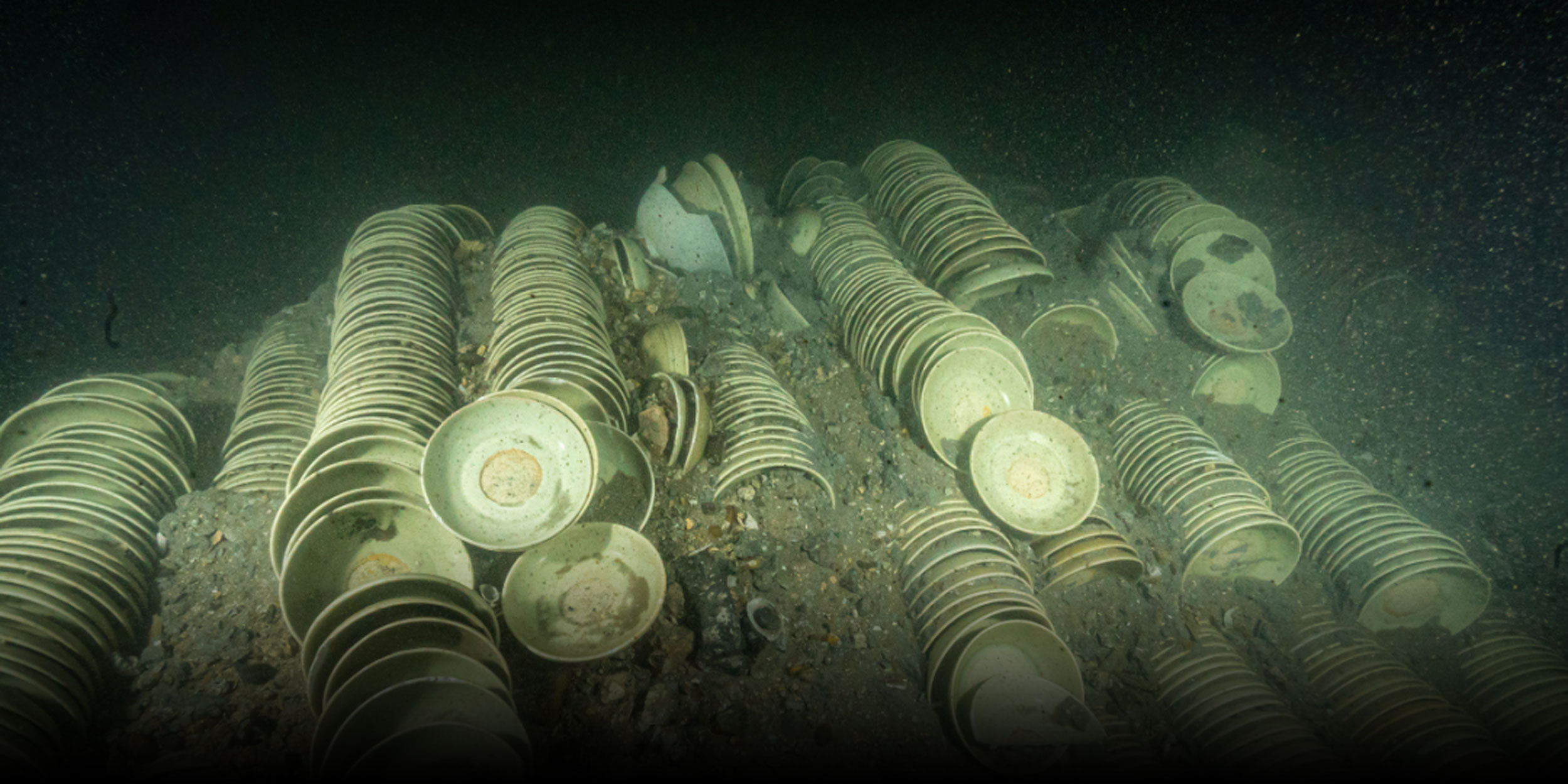
17,000 Shipwrecked Relics Given to Chinese Research Centers
Over 17,000 artifacts recovered from a more than 700-year-old shipwreck off the coast of eastern China have officially been transferred to several Chinese archaeological institutions.
At a Monday ceremony in Zhangzhou City, in the eastern Fujian province, the artifacts were distributed among the Archaeological Research Center of the National Cultural Heritage Administration, the Fujian Provincial Institute of Archaeology, and the Zhangzhou Museum, among others.
The handover marks the first implementation of nationwide trial guidelines issued in July by the National Cultural Heritage Administration. The directive aims to standardize archaeological relic preservation, research, and display, citing an increasing number of archaeological excavations and findings in the country.
Under the new rules, archaeological teams must transfer recovered artifacts to state-owned museums, libraries, or cultural institutions within six months of submitting excavation reports to the National Cultural Heritage Administration and provincial cultural heritage authorities.
The recently transferred artifacts come from a shipwreck dating back to the late Yuan dynasty (1279–1368). Measuring 17 meters long and 4.5 meters wide, the wreck was discovered in 2014 in the waters between Zhangzhou and the nearby Shengbeiyu islet, where the Maritime Silk Road’s southern and eastern routes intersect. The site lies about 30 meters below the surface and is surrounded by reefs and complex waters, making the area prone to shipwrecks.
More than 20,000 artifacts were recovered from the wreck between 2022 and 2023, including over 17,000 celadon — or green-glazed porcelain — bowls, plates, cups, and incense burners. Other finds include pottery jars, lead weights, and seals.
The relics come from the Longquan kiln in the eastern Zhejiang province, one of the largest ceramic production centers in Chinese history and a major source of porcelain for overseas markets. Spanning 1,700 years and renowned for its distinctive jade-green and light-blue glazes, the kiln’s wares became an important commodity in maritime trade networks, reaching markets around Asia and Europe.
Some of the pieces from the shipwreck, including their inscriptions, are unusually large, offering clues about how Chinese kilns adapted their products for overseas markets, according to historical experts.
The ship’s cargo, along with similar finds in east China, suggests it may have set sail from Zhejiang’s coastal Wenzhou City for southeast Asia as a privately operated trading vessel.
“The excavation of the shipwreck marks an important milestone in China’s underwater archaeology,” Liang Guoqing, who led the excavation team, told local media. “It has also allowed the public to see firsthand the thriving trade in Longquan celadon and the prosperity of the Maritime Silk Road during the late Yuan dynasty.”
Archaeologists at the Archaeological Research Center of the National Cultural Heritage Administration said the wreck is also the first Yuan dynasty ship discovered in China with a fully preserved bilge keel — a structure attached to the bottom of a vessel to reduce roll. The discovery provides rare physical evidence for the study of ancient Chinese shipbuilding and navigation.
Editor: Marianne Gunnarsson.
(Header image: Ceramics inside the Yuan Dynasty shipwreck near Zhangzhou, Fujian province. Xinhua)